The Estimating Desk
Construction Estimating and Bid Support, Under Your Own Name
Send us the drawings. We’ll send back a priced, client-ready bid — machine-audited, white-labeled, and usually inside two working days.
Sound Familiar?
“The package is back Friday. Our estimator’s on vacation.”
“We turned down four invitations last month. Not because we didn’t want them — nobody had time to price them.”
“I priced it at the kitchen table on Sunday night.”
“We won it. Then found the firestopping wasn’t in it.”
None of those are estimating problems. They are revenue problems that happen to look like workload.
33
Years Construction & Estimating
2 Days
Typical Turnaround
Your Name
White-Labeled As Standard
$40M+
Largest Single Project Priced
Before You Send Anything
Read a complete pack first.
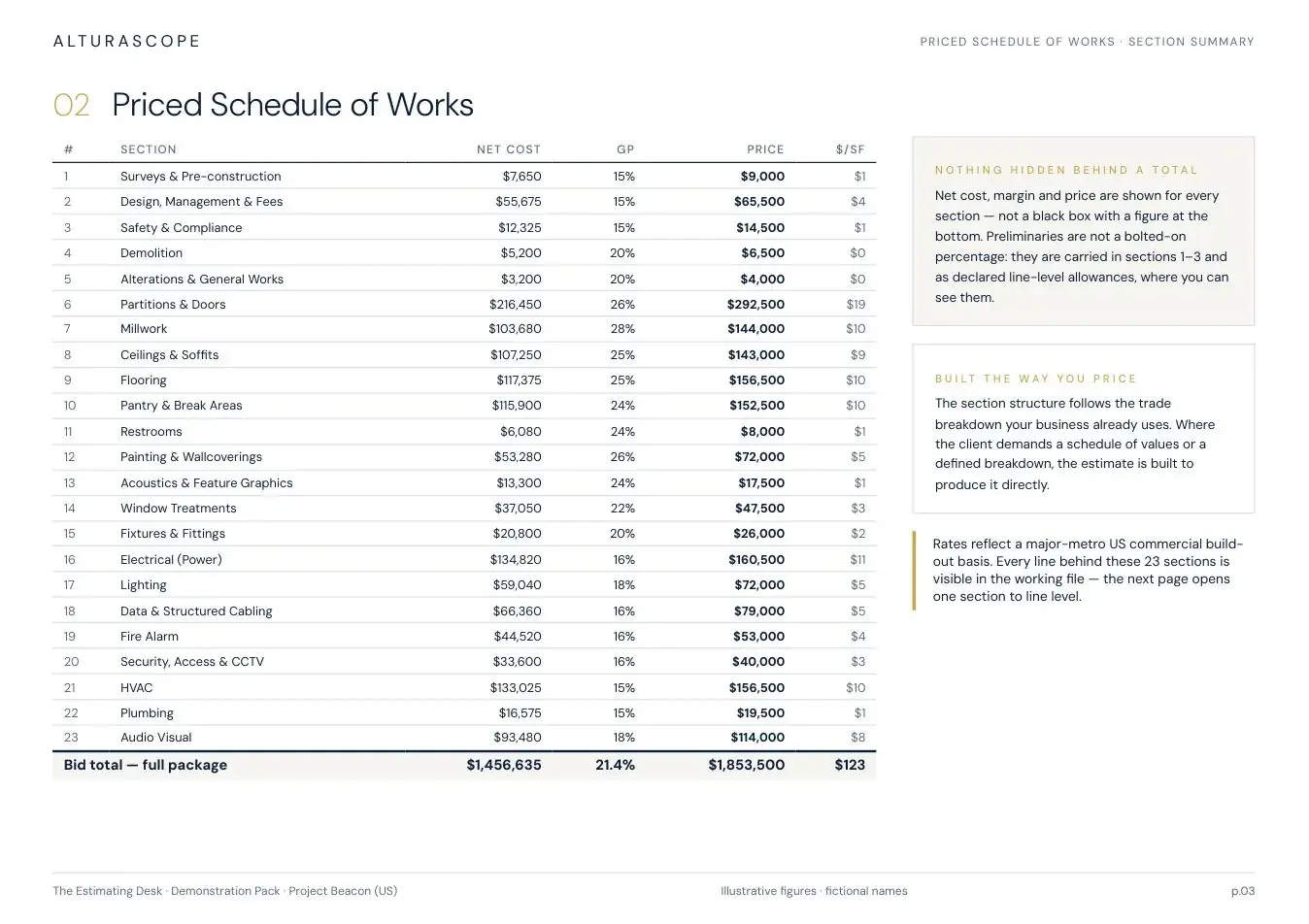
We have published a full demonstration estimate pack — all eleven pages, both a US bid and a UK tender — so you can judge the work before there is anything of yours at stake. Priced schedule, traceable take-off, margin analysis and the audit report, nothing held back for the sales call.
The Problem
Estimating capacity is a ceiling on revenue.
Every contractor knows how many bids they submitted last quarter. Very few know how many invitations they declined because nobody had the hours to price them. That second number is the more important one, because each of those was a job somebody wanted you to win and you chose not to compete for.
The constraint is rarely willingness and it is almost never capability. It is that estimating is bursty and salaries are not. Demand arrives in clusters — four packages land in the same week, all returnable the same Friday — and a permanent estimator sized for the peak is idle for most of the year, while one sized for the average turns work away every time the peak arrives. Estimators are also scarce, expensive to recruit, and they carry the method in their heads, which means the day one leaves is the day bidding stops.
The other half of the problem is what happens after you win. Bids are lost on price, but margin is lost on omissions: the firestopping that was never in the schedule, the quantity that came from a scaled drawing nobody checked, the exclusion somebody made at eleven at night and forgot to write down. A cheap estimate that is wrong is the most expensive document in the business.
An estimating desk you can borrow solves the first problem. Doing it inside a system that will not let an unsourced quantity or an unstated exclusion through solves the second. That combination is what this service is.
What Comes Back
Not a number. A pack you can defend.
Anyone can send you a total. What wins work — and what protects the margin after you have won it — is being able to show exactly how the total was built, exactly what it assumes, and exactly which measurement on which drawing every quantity came from. Every package we price returns the same six things.
Priced Schedule of Works
Every trade section, every line, with quantities, rates and gross profit set out so you can interrogate them — not a black box with a figure at the bottom. The structure follows the way your business already prices, and where you use a schedule of values or a defined breakdown for the client, the estimate is built to produce it directly rather than being reformatted afterwards.
Traceable Quantity Take-Off
Quantities are not typed in. They are measured on the drawing and linked to the line they price, so every figure walks back to the shape it came from on the sheet it came from. We can hand you the drawing rendered with the take-off drawn over it — area fills, run centerlines, count markers — so you can look at what was measured rather than take a number on trust. When your client questions a quantity, the answer is a picture rather than an argument.
Margin Analysis
Gross profit by section and overall, so you can see where the job makes money before you decide what to submit and where you have room to sharpen. Most outsourced estimating stops at the number, which leaves you asking “is this right?” A margin breakdown changes the question to “where do I compete?” — which is a commercial conversation, and a considerably better one to be having the night before a bid goes in.
A Stated Basis of Estimate
Every drawing and specification priced, listed by number and revision, together with inclusions, exclusions, assumptions, allowances and qualifications. It is written to be attached to your submission as it stands, so the scope you priced is the scope on the record. Our Basis of Estimate standard sets out exactly what appears on every pack and why.
A Client-Ready Bid Document
Your letterhead, your terms, your covering narrative — generated from the live numbers rather than typed up afterwards, so the document cannot disagree with the estimate behind it. If you already have a Word or Excel quote template your clients recognize, we produce the bid in yours rather than ours. Presentation moves win rates on price-close bids, and a small firm should not lose one because the submission looked like a spreadsheet next to a competitor's brochure.
The Working File — And It Is Yours
The priced model itself, exportable, together with the rate library we build for you along the way. That library is the real asset: it captures how your business prices, it draws on what materials and subcontracts have actually cost rather than what a price book says they should, and it gets sharper with every job we do. It belongs to you. If you stop working with us tomorrow, you take it with you.
Before You See It
Every pack is machine-audited. It cannot be released while anything is red.
Estimates rarely fail because somebody applied a rate wrongly. They fail because a drawing went unread, a quantity had no source, or something was quietly dropped and nobody noticed until the job was won and the scope was fixed.
So before any pack leaves the desk, the platform runs a fixed set of automated checks across the estimate, the take-off and every document we were sent. They are deterministic rather than discretionary — not a reviewer's good intentions, but rules enforced by the system — and the job cannot be marked complete while any of them is failing. The audit report is issued with the pack, so you can see what was verified.
Provenance
Every priced quantity has a source. A line that is neither linked to a measurement nor cited to a document is flagged. There is no such thing as a number that came from nowhere.
No Silent Drops
Nothing can be excluded without a stated reason. And “we couldn’t measure it” is not an accepted reason — unmeasurable scope has to appear in the estimate at zero, marked to be confirmed, where you can see it. This is the check that stops the firestopping disappearing.
Nothing Unread
Every document you send has to be used or waived. If a drawing or specification we were given is not cited by a single quantity or decision, it is raised before the pack goes out rather than discovered afterwards.
Measure First
Prices cannot exist before measurements do. The take-off has to be the basis of the price, not a justification assembled after the number was reached.
Arithmetic Sanity
Totals are checked against the drawings’ own figures. Where the measured areas and the areas printed on the sheets disagree by more than a set margin, the pack stops and somebody looks at it.
No Double-Counts
The same space drawn twice is caught. Before anything is measured the system reads the drawing register and compares sheets geometrically, so a site plan and a floor plan showing the same footprint at different scales are never measured as two separate floors.
Units
Dimensions have to agree. A linear measurement cannot quietly feed an area rate. Conversions are permitted, but only where they are declared as an assumption you can read.
Drift
Linked measurements are re-checked at the end. If a measurement changed after a line was priced from it, the mismatch surfaces rather than silently persisting into your submission.
The audit is a quality gate on our workmanship. It does not replace your own commercial review — see where responsibility sits.
Who Prices It
A desk, not a person.
Outsourced estimating normally means one estimator with a queue, which is why it is slowest in the week you most need it — when everybody’s deadline lands on the same Friday. Ours is built the other way round.
The Judgment
Thirty-three years of it
Eighteen years in construction and fifteen in estimating, between the two of us. Reading bid documents, arguing about scope, and living with the consequences of both. Working out what a drawing is actually asking for is not something software supplies.
Every pack is reviewed and signed off by a career estimator before it goes anywhere. That signature is the point.
The Capacity
A team of digital colleagues
The mechanical work — measuring the drawings, pulling out the schedules, building the sections, assembling the documents — is done by a team of digital colleagues working inside Vyntworks. They follow our written pricing methods rather than improvising, they work to set approval limits, and every action is logged against a name and a time.
Which means capacity is not what decides whether we can help you. There is no single estimator with a queue.
The Gate
Nothing leaves without both
Every pack passes the automated audit, and then passes a person. The machine catches what a tired human misses at eleven at night; the human catches what no machine can know about your job, your client and your appetite for the risk in it.
Neither on its own would be good enough to put your name on.
Deadline week is the week most estimating services quietly stop answering the phone. It is the week we are most useful. Send us three packages that week rather than one — the desk is built for it.

The Name On It
Someone is accountable for the number.
Eighteen years in construction, several hundred commercial sites documented across the US, Canada and the UK, and a business that lives or dies on whether the information it hands over turns out to be right.
The estimating side is run with Selwyn Doling, a career estimator of fifteen years’ standing, who reviews and signs off every pack before it is issued. Between the platform and the two of us, nothing goes out that neither a machine nor a person has checked.
— Andrew Harris, Founder
How It Works
Four steps. You hold the pen at the end of all of them.
01
You send the package
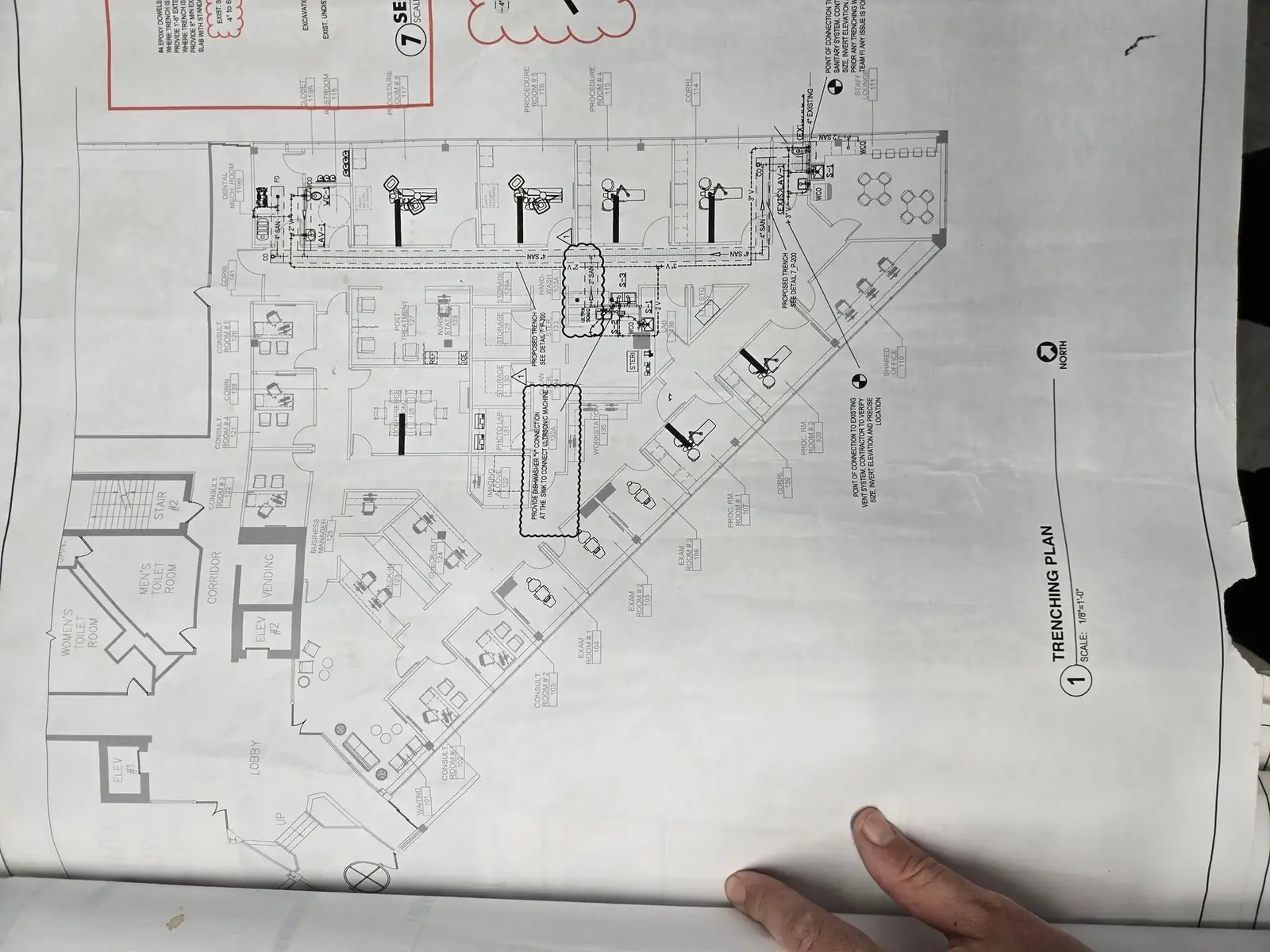
Drawings, specification, invitation to bid — whatever you have. Scans and photographed mark-ups are fine; the take-off handles drawings with no text layer.
02
We agree the basis
One short call. What is in, what is out, whose rates we are using, and the date it has to be back. Ten minutes that prevents every argument later.
03
We price and audit it
Take-off, rates, sections, margin — then the automated checks and a human review. You get a draft with the workings visible, not a finished number handed down.
04
You take it from there
You get a notification that the draft is ready, and the estimate is waiting in your own account — to review, adjust and issue under your name. A PDF arrives at the same time if that is all you want.
When the addenda land. Revised drawings issued mid-bid are where submissions come apart. We re-price against the new revision and hand you a line-by-line difference — what was added, what was removed, what changed, and exactly what it did to the total. No re-reading two hundred pages to find out.
Your Copy of the Job
You don’t get a PDF and a shrug.
Most outsourced estimating ends with a document landing in your inbox. If the number needs changing, you email somebody and wait, and the version everyone is arguing about is whichever attachment they opened last.
When your pack is ready you get a notification, and the estimate is sitting in your own account inside Vyntworks — set up by us, nothing to install, no licence to buy. The PDF arrives at the same time if that is all you want. But if you want to change something, you change it yourself.
Every line, with its margin
Section by section, line by line, with gross profit showing on each. Nothing hidden behind a total.
Move a number, watch the rest move
Change a rate, a quantity or a margin and the section totals and GP update as you type. Sharpen a trade to win the job and see exactly what it costs you.
Click a quantity, see where it came from
Measured lines link back to the shape on the drawing. Open it and look at what was actually measured rather than taking the figure on trust.
Issue it yourself
Generate the client document on your own letterhead, straight from the live numbers, at the moment you are happy with it.
One version, and everybody is looking at it. Because the estimate lives in one place rather than in six attachments, the number your estimator changed on Thursday is the number your client sees on Friday. There is no reconciling versions, and no document that quietly disagrees with the model behind it.
Where Responsibility Sits
It comes back as a draft. It goes out as yours.
We produce estimates, not warranties — the same as any estimator you would employ. What we owe you is a competent, transparent, fully-sourced build-up of the price. What you owe yourself is the commercial judgment on top of it: the appetite for the risk, the read on the client, the decision about what to submit.
So every pack states in writing exactly what it was priced from and exactly what it assumes, and nothing leaves your office until you have reviewed it and signed it off. Checking quantities, rates and scope against your own knowledge of the job remains your call — and between the traceable take-off, the automated audit and being able to open the estimate and interrogate it line by line yourself, that check takes an hour rather than a weekend.
That is not us covering our backs. It is how the trade has always worked, written down properly for once. Our Basis of Estimate standard sets it all out, and it is issued with every pack rather than buried in a footer.
Every pack states its basis, carries its audit report, and waits for your sign-off. Two revisions are included, we sign your non-disclosure agreement before the drawings arrive, we will not price the same package for two bidders, and the liability position is stated plainly in the engagement terms rather than buried in a footer.
The Software
We are not being coy about it. It is Vyntworks.
We do not price faster by working later. Every package runs through Vyntworks, an operations platform built for contractors that covers estimating, procurement and cost control in one connected system — with the take-off, the automated audit and the document generation all inside it.
Your rate library lives in it and gets sharper with every job we do for you, drawing on what things have actually cost rather than what a price book says they should. Which is why the second package comes back faster than the first, and the tenth faster again.
Plenty of estimating services will not tell you what they run on. We will, for a straightforward reason: you will be using it yourself from the first package, because that is where your estimate is waiting for you.
You already have an account. Every client gets one, set up by us, at no cost and with no licence attached — it is simply where your estimate is waiting. Licensed properly, the same system carries the job on through purchase orders, subcontract packages, cost control and the final account, and the quote you won becomes the budget without anything being re-keyed.
What Nobody Else Can Do
We can price the building. Not just the drawing.
Renovation and build-out estimates go wrong in the gap between what the drawing says and what the building actually is. The riser that is not where the as-built shows it. The ceiling void a foot shallower than anyone assumed. The three-phase supply nobody checked. None of it is on the drawings, and all of it is in the price you committed to.
Alturascope has documented over five hundred commercial buildings across the United States, Canada and the United Kingdom — digital twins and conditions reports, above-ceiling MEP capture, thermal imaging and equipment schedules. On a renovation we can survey the site and price the work from the same record.
No other estimating bureau can survey the building. No other survey firm can price the work. If your risk on this job is what is behind the walls, that combination is the entire point — and it is available on one instruction, from one vendor, with travel included.
We don’t build it, so we have no reason to want the number to be anything but right.
We do not contract, we do not supply materials, and we do not take a percentage of the job. We also will not price work on a site we have documented for the other side of the table — and if that ever comes up, we will tell you before you tell us.
Going Further
We can go out to your supply chain, too.
Pricing from a rate library is fast. Sometimes it is not enough — the package carries a specialist element, or the job is large enough that you want real prices from real subcontractors before you commit a number to a client.
We can run that enquiry for you: package the scope by trade, send the request out to your suppliers and subcontractors, chase the returns, and put them side by side against the same lines so you are comparing like with like. The price you select drops straight back into the estimate without being re-keyed.
Your relationships, your supply chain, your terms. We run the process, and you keep every commercial decision in it.
What that adds
Trade packages split out of the estimate, scoped and ready to send.
A comparison board — every return against every line, leveled so the gaps are visible.
Chasing handled, so returns actually arrive before your deadline rather than after it.
Selected prices applied back into the estimate with nothing typed twice.
If you win, the same packages become your purchase and subcontract orders.
Engagement
Three ways in. Start with the one that costs you nothing.
Start Here
The first one is on us
Send your next live package. If the pack that comes back is not faster and better than what you would have produced yourself, you owe us nothing and we part as friends.
No fee
One package, one company, once.
Per Package
Priced job by job
Every package is quoted before we start, as a fixed fee, banded by contract value and complexity. No retainer, no minimum, no notice period.
Fixed fee, agreed up front
Two revisions included. Supply-chain enquiry quoted separately.
Retained Desk
Your estimating desk, on tap
An agreed number of packages a month, a named estimator who learns how you price, and a rate library that compounds. Priority in deadline weeks.
Monthly, rolling
Scoped to your bid volume. Thirty days’ notice.
One honest caveat on the pricing. There is a bid volume past which retaining us stops making financial sense — above it you are better off licensing Vyntworks and running the desk in-house. We will tell you when you reach it, and we will help you make the move.
Questions We Get Asked
Before you send us anything.
How fast can you turn around a bid package? +
The standard turnaround is two working days from the point we agree the basis of the estimate. Repeat work priced from a rate library we have already built for you is frequently faster. Tell us the return date before anything else and we will give you a straight yes or no on whether we can hit it — we would rather decline a package than miss a bid deadline, because a late bid scores zero rather than a lower number.
Are you going to price the same job for our competitor? +
No. One package, one bidder, first to instruct. If we are already pricing a package you send us, we tell you immediately and decline the work. This is written into our engagement terms rather than being a matter of goodwill, and we will sign your non-disclosure agreement before any drawings change hands.
Who actually does the estimating? +
A desk rather than a single person. Between us we have thirty-three years of construction and estimating experience, and every pack is reviewed and signed off by a career estimator before it is released. Alongside that, a team of digital colleagues working inside the Vyntworks platform handles the mechanical work — measuring the drawings, extracting schedules, building the trade sections and assembling the documents. They follow our written pricing methods rather than improvising, they work to set approval limits, and every action is logged. You get the capacity of software with the judgment of someone who has priced this kind of work for years.
What software do you use, and why does that matter to me? +
Vyntworks — an operations platform built for contractors, covering estimating, procurement and cost control in one connected system. It matters to you directly, because you get an account on it. When a pack is ready you are notified, and the estimate is waiting there for you to review, adjust and issue rather than arriving as a flat document you can only accept or query. It is also where the speed, the traceable take-off and the automated checks come from. There is no licence attached to the account we set up for you, and if your bid volume ever makes running the whole thing in-house the cheaper answer, we will tell you and help you move.
Do we have to use the software? +
No. Every client gets an account because it is the fastest way to hand over an estimate you can actually interrogate, but plenty of people never log in and simply work from the PDF and the emailed summary. If you would rather we made every change, two revisions are included in the fee and you can send the rest by email. The account costs you nothing either way and carries no licence or commitment.
Who can see our estimate in there? +
You and the people you invite from your own business, plus the estimator working on your package. Your documents and your rate library sit in a tenancy specific to your company and are never pooled with, or used to price work for, anybody else. If you stop working with us, the rate library and priced models are yours and are exportable on request.
How accurate is the estimate? +
As accurate as the information we are given and the rates we are working from, which is exactly why every pack states both. Every priced quantity is traceable to the measurement or document it came from, and the pack is machine-audited before release: nothing can be priced without a source, nothing can be excluded without a stated reason, and every document you send has to be used or explicitly waived. Where the drawings will not support a firm price we carry a stated allowance rather than a guess, and it appears in the estimate where you can see it rather than quietly falling out.
Whose rates do you price from? +
Yours, wherever you have them. Most contractors have rates scattered across old spreadsheets and one estimator's memory, so part of the first job is pulling those into a proper rate library — we can import your existing Excel estimates to do it. Where you have gaps we price from published rate data or go out to your supply chain for real prices, and we mark clearly which is which. The library belongs to you and is exportable at any time, including if you stop working with us.
Will our client know you were involved? +
Only if you tell them. Everything is produced on your letterhead in your format, including your own Word or Excel quote template if you have one. We never contact your client, we are not named in the documents, and the estimate is issued by you under your name. The work is white-labeled as standard rather than as an extra.
Our drawings are scans and mark-ups. Is that a problem? +
No. The take-off reads scanned and photographed drawings as well as native PDFs, and reads the sheet number, title and declared scale from each drawing's own title block. Poor documents widen the assumptions we have to state and can slow us down; they do not stop us. A phone photograph of a marked-up plan is a legitimate starting point.
What happens when the addenda land mid-bid? +
We re-price against the new revision and hand you a line-by-line difference — what was added, what was removed, what changed, and exactly what it did to your total. Revised drawings issued late in a bid period are one of the most common ways a bid comes apart, and reading two hundred pages again to find the changes is exactly the work you should not be doing at that point.
Do you price work in the United Kingdom as well as North America? +
Yes. Alturascope runs a UK operation alongside its US and Canadian coverage, and packages are priced in the conventions, contract forms and currency of wherever the job is. If your work is in Britain, our UK estimating page sets it out in the terms a UK contractor or quantity surveyor expects.
Send a Package
Is there a package on your desk right now?
Tell us the return date first. We will come back the same working day with a straight yes or no on whether we can hit it — and if it is your first, there is no fee attached to finding out.
We sign your non-disclosure agreement before any drawings change hands, as a matter of course. Just say so in the brief.
Working in Britain? Visit our UK estimating desk →