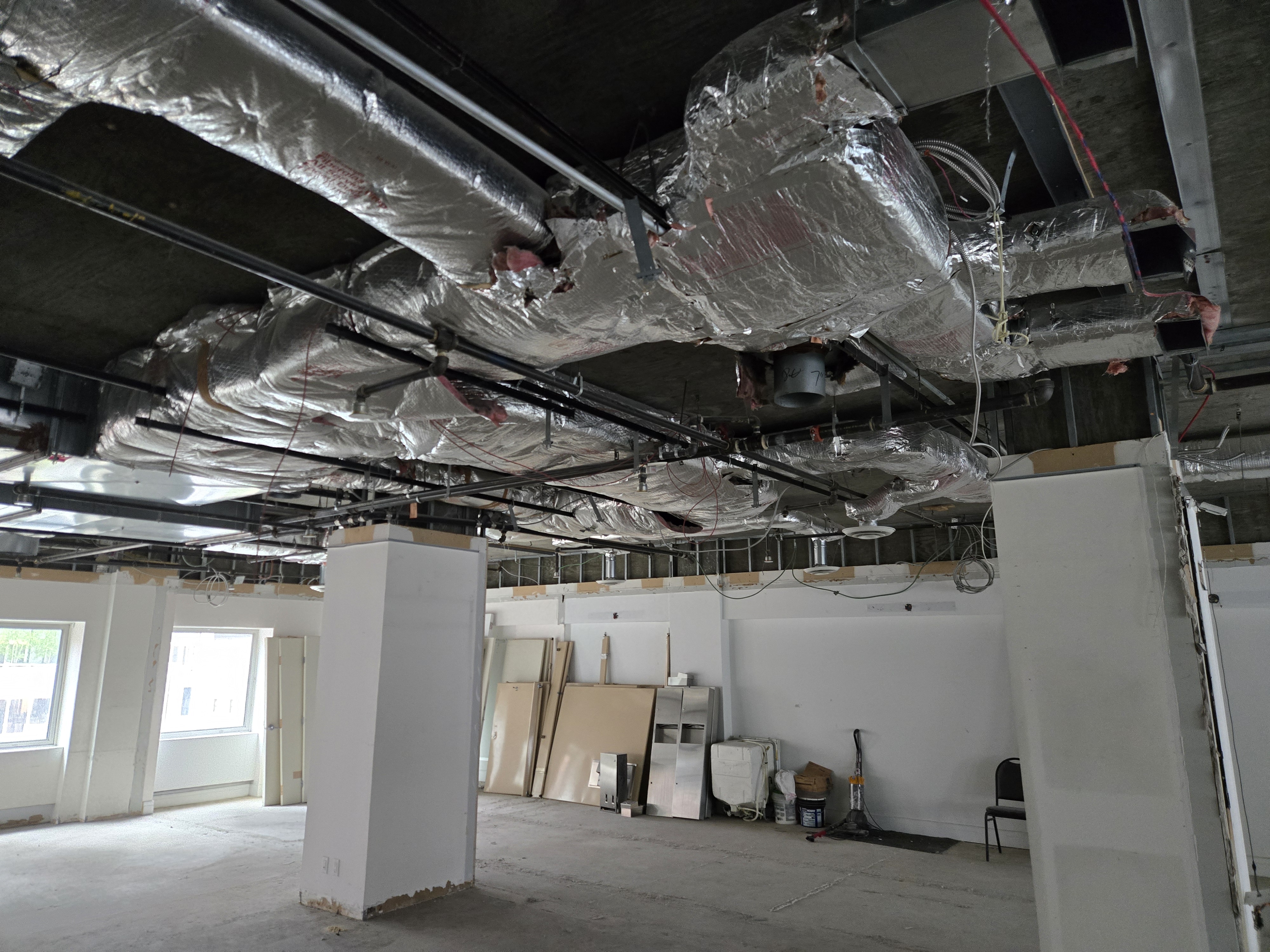
Data center capacity is being consumed faster than it can be built. AI training workloads, cloud migration, and edge computing demand are driving expansion programmes at hyperscale operators, colocation providers, and enterprise facilities alike. Whether you're adding white space to an existing campus, retrofitting a legacy facility for higher power density, or planning a major equipment refresh, every project starts with the same requirement: accurate documentation of what's already there.
The problem is that data center facilities are among the most complex built environments to document. The density of MEP systems, the criticality of operational continuity, and the security constraints around access all create challenges that standard survey methodologies aren't equipped to handle.
Why Standard Surveys Fall Short in Data Centers
A data center isn't a building that happens to contain IT equipment. It's a precision-engineered environment where power, cooling, fire suppression, and structural systems are interdependent at a level that most commercial buildings never approach. A survey that documents walls, floors, and ceiling heights but misses the power distribution architecture or the cooling airflow design is essentially useless for expansion planning.
The specific challenges include:
Power Distribution Architecture
From utility feed to PDU, the power chain in a data center is multi-layered and critical. The survey needs to document transformer locations and capacities, switchgear configuration, UPS systems (make, model, capacity, age, battery condition indicators), generator infrastructure, bus duct and cable tray routing, and PDU positions relative to rack rows. For expansion projects, the design engineer needs to know not just what exists but what capacity remains — and whether the existing infrastructure can support higher per-rack power density without upstream upgrades.
Cooling Infrastructure
The cooling design is inseparable from the revenue model. Every kilowatt of IT load requires cooling, and the efficiency of that cooling directly affects operating costs. The survey needs to capture CRAC and CRAH unit positions, capacities, and conditions, hot aisle and cold aisle containment configurations, raised floor plenum depth and tile layout, chilled water piping routes and valve positions, and any evidence of airflow bypass or recirculation. This is where thermal imaging becomes critical — it reveals the actual thermal profile of the facility during operation, identifying hotspots and cooling inefficiencies that visual inspection cannot detect.
Cable Management and Pathway Capacity
Cable tray fill rates, fibre routing paths, and conduit capacity are among the most common constraints in data center expansion projects. The survey should document tray routing, approximate fill levels, pathway bottlenecks, and available capacity for additional runs. In retrofit scenarios, the existing cable infrastructure often determines what's feasible without major pathway construction.
Fire Suppression and Life Safety
Clean agent systems, VESDA detection, pre-action sprinkler zones, and EPO configurations all need to be documented accurately. Any expansion that changes the protected volume or adds openings to fire-rated boundaries triggers re-evaluation of the suppression design. Having accurate documentation of the existing system before design begins avoids costly surprises during permit review.
The Thermal Imaging Advantage
A standard survey captures what a facility looks like. A survey with integrated FLIR thermal imaging captures what it's actually doing. In a data center, this distinction is the difference between documentation and intelligence.
Thermal capture during a data center survey reveals:
Equipment hotspots — individual servers, switches, or PDUs operating above normal thermal thresholds, indicating potential failure or overload conditions
Cooling containment breaches — hot air recirculation through gaps in containment panels, blanking plates, or unsealed cable cutouts that reduce cooling efficiency
Power distribution anomalies — thermal signatures at connections, breakers, and busbars that indicate loose connections, phase imbalance, or approaching failure
Airflow pattern validation — whether the actual thermal environment matches the designed cooling strategy, or whether the facility has drifted from its intended operating profile
This data is delivered as a thermal overlay within the survey package, geo-referenced to the digital twin and the conditions report. For facilities teams planning expansion, it provides a layer of operational intelligence that drawings and floor plans simply can't offer. Our guide to documenting controlled environments explores this approach in more detail across data centers, cannabis facilities, and other precision spaces.
What Design Engineers Need from the Survey
For expansion and retrofit projects, the design team needs more than photographs and a floor plan. They need dimensionally accurate spatial data that integrates directly into their CAD and BIM workflows.
A professional data center survey delivers:
Millimetre-accurate point cloud data
LiDAR scanning captures the full geometry of the space — structural elements, equipment positions, cable tray routing, raised floor configurations — exportable as .e57 or .rcp for direct integration with Revit, AutoCAD, and other design platforms
Navigable digital twin
A Matterport digital twin that allows the entire project team to explore the facility remotely, reducing the need for repeated site visits during the design phase
Structured conditions report
A prioritised assessment of existing conditions that affect the project scope — from structural loading capacity to ceiling clearances to any equipment approaching end-of-life that should be addressed during the expansion
MEP system documentation
Detailed photographic and spatial documentation of all mechanical, electrical, and plumbing systems visible on site — with equipment schedules including make, model, and service connection data
Security and Access Considerations
Data center surveys require a different operational approach than standard commercial buildings. Security protocols, NDA requirements, restricted zones, and escort requirements are standard. The survey methodology needs to accommodate these constraints without compromising the quality or completeness of the documentation.
We work within your security framework: badged access, escorted capture where required, data handling protocols that meet your operational security requirements, and scheduling around maintenance windows when access to restricted zones is available.
Frequently Asked Questions
Can you survey a live data center without disrupting operations? +
Yes. Our survey methodology is designed for live operational environments. Matterport and LiDAR capture is non-contact and non-invasive. Thermal imaging is conducted without disrupting airflow or power systems. We work within your security protocols, access restrictions, and operational windows.
What does thermal imaging reveal in a data center? +
Thermal imaging identifies hotspots from failing or overloaded equipment, cooling inefficiencies including hot aisle containment breaches, power distribution anomalies at PDU and UPS level, and airflow patterns that don't match the designed cooling strategy. These findings are documented as a thermal overlay within the survey deliverable package.
Do you provide survey-grade point cloud data? +
Yes. We capture millimetre-accurate point cloud data using LiDAR scanning, suitable for integration with Revit, AutoCAD, and BIM workflows. This is particularly important for retrofit and expansion projects where new equipment, cable tray, or cooling infrastructure needs to be designed into an existing space with tight tolerances.
Can you document data centers in both the US and UK? +
Yes. Alturascope operates across all 50 US states, every Canadian province, and the United Kingdom. For operators with facilities in multiple countries, we deliver consistent documentation using the same methodology and deliverable format regardless of location.
The Bottom Line
Data center expansion and retrofit projects are too complex and too expensive to build on assumptions about existing conditions. A professional survey — combining spatial accuracy, thermal intelligence, and structured documentation — gives your design and facilities teams the verified baseline they need to plan with confidence.
Talk to Alturascope about documenting your facility. We'll confirm methodology, timeline, and an all-in quote within one business day.
Alturascope delivers data centre documentation across all 50 US states, every Canadian province, and the United Kingdom.